
Key highlights
- At Luxembourg Internet Days 2026, Xavier Hermès, Head of IT Security at BCE, highlighted the importance of security, sovereignty and resilience in critical infrastructure.
- Technological sovereignty is not about isolation, but about maintaining strategic options through choice, portability and diversification, while keeping critical dependencies visible and manageable.
- BCE’s pragmatic approach combines hybrid architectures and multiple technology ecosystems to preserve flexibility, scalability and technological freedom of choice, while ensuring operational resilience.
At Luxembourg Internet Days 2026, BCE’s Head of IT Security made the case for trusted infrastructure: knowing what critical services depend on, and being able to change course when circumstances change.
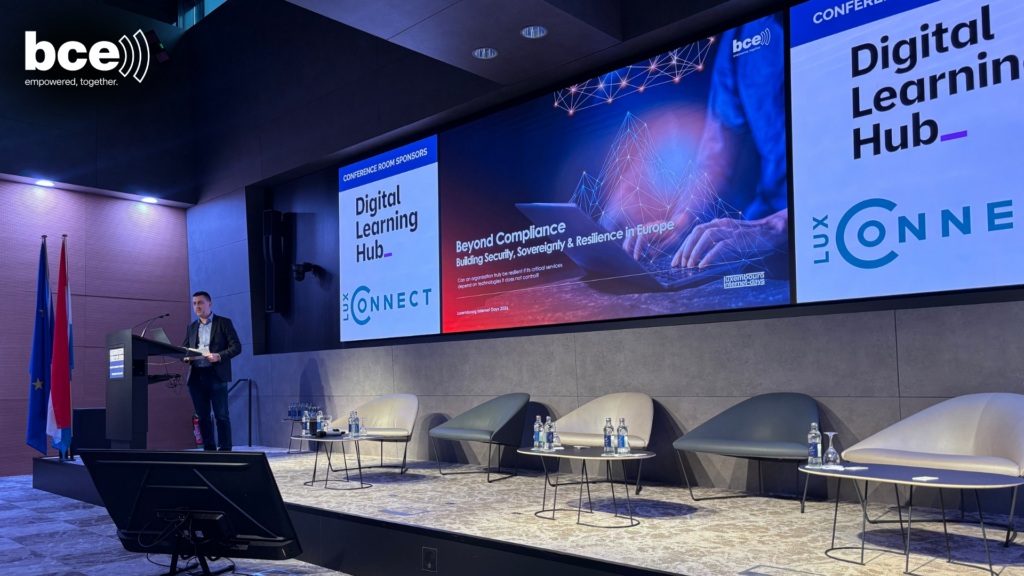
Luxembourg, 23 November 2026 – BCE took part in the 13th edition of Luxembourg Internet Days (17–18 November), the annual event organised by LU-CIX at the Luxembourg Chamber of Commerce. The event brings together ICT professionals, technology decision-makers and business leaders around key challenges in cybersecurity and digital infrastructure. This year’s edition focused on security, sovereignty and resilience.
During his session on 18 November, “Beyond Compliance: Building Security, Sovereignty and Resilience in Europe”, Xavier Hermès, Head of IT Security at BCE, addressed a question that now reaches well beyond IT departments: how to benefit from interconnected, cloud-based and software-defined technologies while keeping control of the dependencies that critical operations rely on.
His talk reflected BCE’s approach to technological sovereignty and trusted infrastructure. Compliance provides an essential framework, but resilience also depends on an organisation’s ability to understand its dependencies, retain strategic options and keep its freedom of choice as technologies and requirements evolve.
Beyond compliance: when dependency becomes a business risk
European frameworks such as NIS2 and the Critical Entities Resilience Directive (CER) are widening the security discussion to include governance, supply-chain security, business continuity and third-party dependencies. NIS2 requires management bodies to approve and oversee cyber-risk measures, and holds them accountable for them, while CER looks at the all-hazard resilience of essential services, including what they depend on. But compliance alone does not remove technological dependency.
A service can look compliant on paper, with security controls, backups and a continuity plan, while still relying on a single provider and an exit that has never been tested. In that situation, technological dependency is no longer only an IT issue: it becomes an operational and business risk.
The question is increasingly relevant for corporate and media organisations alike, as they become software-defined, IP-based and cloud-based. Production, content management, processing and distribution of audiovisual content now rely on interconnected technologies and providers. For these environments, trusted infrastructure starts with knowing where critical dependencies sit.

For BCE, this evolution is already part of how media environments are designed and operated. From media infrastructure and systems integration to cloud-based services, content management and distribution, BCE connects environments and technology ecosystems across the media supply chain, and takes responsibility for the result. This gives BCE a practical view of sovereignty: resilience has to be considered across the workflows and dependencies that keep media operations running.
“Technological sovereignty does not mean isolation. It is about maintaining strategic options. Choice, portability, diversification.”
Xavier Hermès, Head of IT Security at BCE
Sovereignty means preserving control and choice
Xavier Hermès approached sovereignty across four dimensions: data (where it is and who can access it), operations (who runs and administers the service), technology (who can change, reprice or withdraw it) and legal jurisdiction (which law applies, beyond where data is stored). Hosting data in Europe matters, but location is not control: it does not automatically remove dependencies on applications, cloud services, networks, identity services or technology providers.
Sovereignty is therefore not isolation, and not every technology has to be European. Infrastructure earns trust when its critical dependencies remain understood, governable and reversible. This is the principle behind BCE’s approach: architectures that preserve choice, portability and the ability to evolve, while keeping critical dependencies visible and manageable.
Designing resilience into the architecture
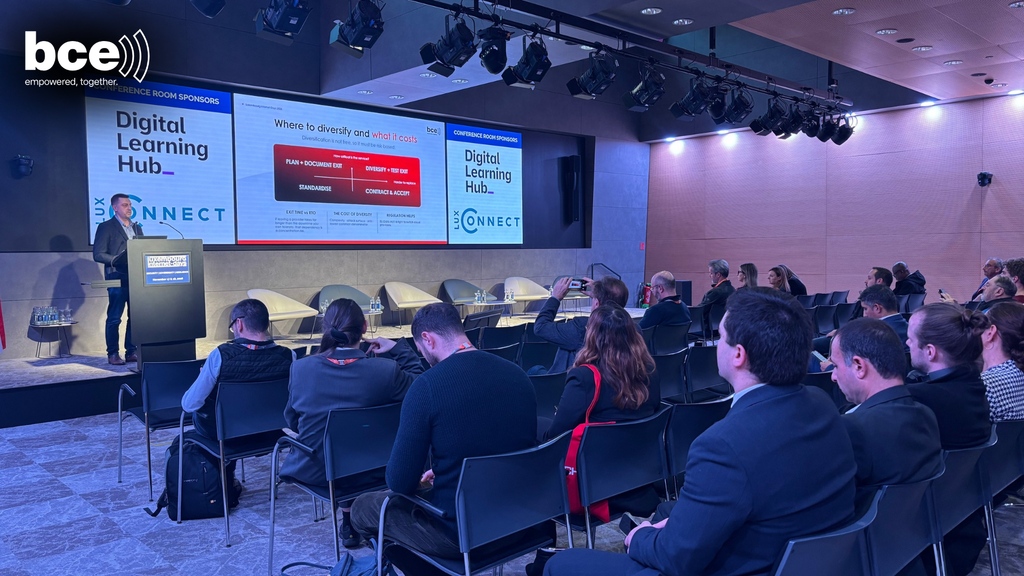
Turning these principles into operational resilience means understanding not only what an organisation depends on, but how hard each dependency would be to replace. One practical measure presented by Xavier Hermès compares exit time with Recovery Time Objective (RTO): if a critical service can tolerate only a few hours of interruption but replacing one of its technology dependencies would take months, that gap is a concentration risk to be understood and managed. The trigger need not be a technical failure: a cyberattack, a geopolitical issue, a legal constraint, a contractual dispute or a strategic change by the provider can be enough.
Diversification is not automatically the answer. It adds cost, complexity, attack surface and skills requirements, so it should be applied where the risk justifies it, and exit plans for the most critical services should be tested, not just documented. Regulation is starting to help: the EU Data Act, applicable since September 2025, gives customers a right to switch cloud providers and phases out switching charges, which providers will generally no longer be able to levy from January 2027. Security teams cannot do this alone: architecture, procurement, legal, business continuity and management all need to be part of the discussion.
From principle to practice at BCE
BCE’s customers expect flexibility, scalability and, increasingly, Media-as-a-Service. Cloud is part of that future, but moving to it should not mean shifting dependencies from one’s own infrastructure to a single external provider. BCE’s approach is therefore pragmatic: hybrid architectures and multiple technology ecosystems.
As an integrator, BCE works across private infrastructure, cloud environments and specialised technology ecosystems, and selects the environment that fits each workload and each customer’s operational, regulatory and business requirements: on-premise where operational control matters most, for critical infrastructure and for legacy and specialised media systems; European cloud where sovereign options are needed; and other providers where best-of-breed services or specialised capabilities add real value. Technology partners are chosen for the role they play in the customer’s workflow, and BCE remains responsible for the overall service.
BCE’s Media-as-a-Service (MaaS) offering illustrates the approach. To provide MaaS with EU resilience and sovereignty, BCE works with Scaleway on European cloud capabilities in addition to AWS. The lesson shared in the session: sovereignty-by-design must be compatible with business plans and expected prices, and sometimes it is even cheaper. Nor is a European provider automatically more secure or more resilient: sovereignty is not a label but a risk-management decision, assessed like any other. The aim is never to replace one dependency with another.
Building technological freedom of choice
For BCE, this is where security, sovereignty and resilience come together. Compliance defines what is required, resilience asks whether operations can continue, and sovereignty asks what an organisation actually controls. The objective is not technological independence but technological freedom of choice: selecting the right technologies and environments while keeping enough control to operate, adapt, move or recover as circumstances evolve.
Xavier Hermès closed with three actions any organisation can start on Monday morning: map the top dependencies of one critical service, compare exit time with RTO for the riskiest one, and run a tabletop exercise simulating its loss for 72 hours. Understanding dependencies, designing portability where it creates real value and testing the loss of a key dependency are what turn sovereignty from a principle into an operational capability.
“Technological sovereignty is not about independence from technology. It is about the freedom to choose our technology.”
Xavier Hermès, Head of IT Security at BCE.