

“Sovereignty is not about where infrastructure is located. It is about preserving the freedom to choose the right technology, the right operating model and the right architecture for every media workflow while maintaining the performance, predictability and operational control required for long-term resilience.”
— Sylvain Merle, CTO at BCE
The media industry is undergoing one of the most significant infrastructure transformations in its history. Traditional broadcast environments are increasingly being complemented or replaced by cloud-based workflows supporting content preparation, distribution, playout, OTT services, remote production, AI enrichment and collaboration across distributed teams.
Cloud technology offers compelling advantages: elasticity, faster deployment cycles, automation, global accessibility and access to advanced services. Yet the challenge is no longer whether cloud should be adopted. The question is how to embrace cloud while maintaining operational resilience, strategic independence and long-term control, without sacrificing the agility and innovation that cloud enables.
At BCE, we believe resilience and sovereignty are closely linked. Resilient media architecture is not simply one that survives technical failures. It is one that preserves operational continuity despite technological, commercial, regulatory or organizational change.
The new reality of Media Operations
Modern media workflows operate in an environment defined by fragmentation, speed and scale.
Content is distributed across linear television, OTT platforms, FAST channels, social media and on-demand services. Assets are repurposed into multiple formats, languages and regional variants, while production and post-production teams increasingly collaborate remotely. At the same time, audiences expect content to be available instantly and continuously.
These pressures expose the limits of traditional infrastructure models. Systems designed around fixed capacity, centralized storage and tightly coupled workflows struggle to adapt to fluctuating demand and rapidly changing business requirements.
Why Cloud alone does not create resilience
A common misconception is that moving workloads to the cloud automatically improves resilience.
In reality, cloud infrastructure provides capabilities, not outcomes. Availability zones, scalable compute resources and managed services offer powerful building blocks, but media organizations do not consume infrastructure, they operate workflows.
This distinction is critical. A cloud provider’s SLA may guarantee infrastructure availability, while broadcasters ultimately measure success through service continuity. Their concern is whether channels stay on air, content reaches viewers on time and operational teams can respond effectively when incidents occur.
True resilience therefore depends on architecture, integration, monitoring, automation and operational discipline as much as it depends on infrastructure availability.
Sovereignty as a resilience strategy
Sovereignty is often reduced to data residency. While data location remains important, this definition is too narrow for modern media environments.
From BCE’s perspective, sovereignty is fundamentally about maintaining freedom of choice. This includes control over where content is stored, which legal jurisdictions apply, who operate critical services, how technology components can be replaced and how commercial dependencies are managed over time.
Viewed through this lens, sovereignty becomes a resilience strategy.
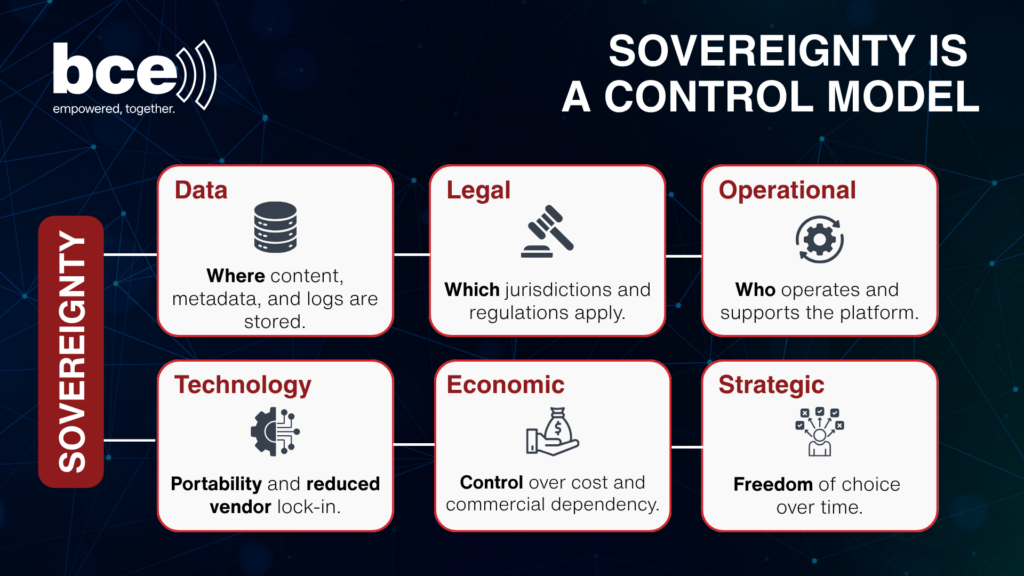
Organizations that depend entirely on a single provider, platform or operating model may face risks that are not technical in nature. Changes in pricing structures, contractual conditions or service availability can have direct operational consequences.
A sovereign approach does not mean limiting technology choices. Instead, it means preserving the ability to select the most appropriate solutions according to technical requirements, operational needs and business objectives. The goal is not isolation but flexibility.
When implemented correctly, sovereignty does more than reduce risk. It enables media organizations to innovate with greater confidence, accelerate the deployment of new services, optimize workload placement and adapt their operating models as business requirements evolve. In this sense, sovereignty becomes an enabler of agility, scalability and long-term innovation as much as a mechanism for control.
From Cloud SLA to broadcast continuity
One of the most important lessons from cloud transformation projects is that broadcast-grade services do not emerge automatically from cloud infrastructure.
Media workloads introduce requirements that differ significantly from traditional enterprise IT environments. Live contribution feeds, playout systems, remote commentary workflows and content management platforms all have different sensitivities to latency, throughput, storage performance and recovery objectives.
As a result, resilience must be evaluated across multiple dimensions:
- Network latency
- Storage and processing performance
- Multi-zone and multi-region architecture
- Automated failover capabilities
- Recovery point and recovery time objectives
- Workflow observability
- Incident response readiness
- Operational support models
The operating model becomes just as important as technical architecture.
Runbooks, service ownership, monitoring frameworks, disaster recovery testing and Site Reliability Engineering (SRE) practices are not optional. They are essential components of media resilience. A platform capable of surviving infrastructure failure but lacking operational readiness is not resilient, it is merely redundant.
The BCE approach: building sovereign Media Operations
At BCE, we see sovereign cloud as part of a broader transformation towards sovereign media operations.
The objective is not simply to migrate infrastructure. It is to modernize media workflows while maintaining control over performance, cost, security and operational continuity.
This approach combines three complementary layers: a sovereign cloud foundation providing compute, storage, networking and observability; specialized media technologies supporting encoding, transcoding, packaging and streaming; and an orchestration layer covering integration, automation, metadata management, monitoring, FinOps and business continuity.
The value does not come from any individual component. It comes from the ability to integrate these layers into repeatable, observable and operationally mature media services.
Conclusion
The future of media infrastructure is neither purely on-premises nor entirely cloud-based. It is hybrid, distributed and increasingly software defined.
In this environment, resilience cannot be treated as a feature added after deployment. It must be designed into architecture, workflows and operating models from the beginning.
Sovereignty plays a critical role in this process, not because it dictates where technology should come from, but because it preserves the ability to choose the most appropriate solutions while maintaining control over operational outcomes.
For media organizations, resilience is no longer simply about recovering from failure. It is about ensuring continuity, adaptability and independence while accelerating innovation, improving operational efficiency and preserving long-term freedom of choice.
Ultimately, the most resilient media architectures are those that combine technical excellence with operational discipline and strategic freedom of choice.